
Reviewed · SAINT JOHN NEW BRUNSWICK TOURS
Pete’s Historic Walking Tour
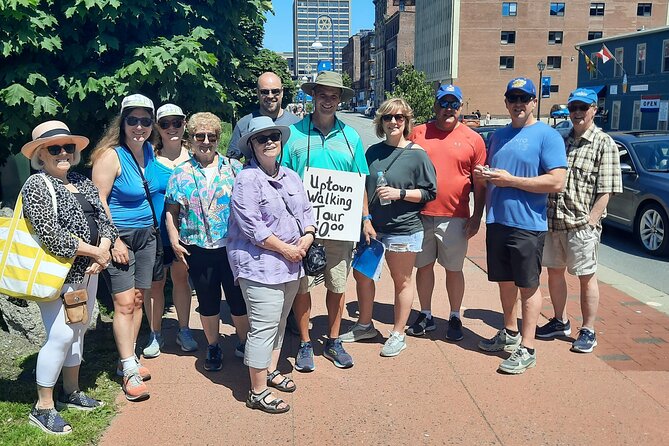
Saint John reveals itself one story at a time. Pete’s Historic Walking Tour brings the city alive through local tales, rare photographs, and a route linking the waterfront, old market, churches, theatres, and grand commercial streets. I like the mix of major sights and small surprises, and I like that Pete Ferguson draws on a lifetime in Saint John, including 35 years connected with Pete’s Pub. The main consideration is time: two and a half hours includes plenty of standing while Pete talks, so anyone hoping for a brisk walk or long shopping stop may find the pace slow.
This is a friendly, low-cost introduction to uptown Saint John. Pete uses humor, speaks clearly without a microphone, and keeps the group small, with a maximum of 20 people. The route can use pedways, escalators, and an elevator to avoid the steepest hills, though you should still expect a moderate level of walking and outdoor weather.
In This Review
- Key points to know before you go
- Why Pete’s Saint John tour works
- From Water Street to the Loyalist Landing
- City Hall, Pete’s Pub, and the City Market
- Charlotte Street murals and the park at King’s Square
- The Imperial Theatre and Admiral Beatty
- Trinity Church and the Loyalist story
- Princess Street and the old Wall Street of Canada
- Three Sisters Lamp and the modern waterfront
- Pace, hills, group size, and practical comfort
- Is $33.80 a fair price?
- Who should book Pete’s Historic Walking Tour?
- FAQ
- How long is Pete’s Historic Walking Tour?
- How much does the tour cost?
- Where does the tour start?
- What language is the tour offered in?
- Are morning and afternoon times available?
- Is the tour suitable for people with limited mobility?
- Should you book it?
Key points to know before you go
- Rare photographs add context: Pete uses copies of old images to show how Saint John looked before fires, redevelopment, and changing waterfront use.
- A local guide with strong connections: Pete’s years owning a pub mean he often knows people around town and adds personal stories to the formal history.
- The walk covers 1783 to today: Loyalist settlement, the Great Fire, Irish immigration, banking, theatre, industry, and the modern cruise port all have a place.
- The route is easy but talk-heavy: Frequent stops make the walk manageable, yet you may spend more time listening than moving.
- The market stop is brief: You get a look at Canada’s oldest continuously operating market, with only a few extra minutes to browse.
- The value is strong: At $33.80 per person, the tour gives you 150 minutes of local interpretation for less than many larger city tours.
Why Pete’s Saint John tour works
Saint John is not a city built around one giant attraction. Its appeal comes from layers: Loyalist streets, fire scars, old financial buildings, working waterfront stories, churches, murals, theatres, and local characters. Pete’s tour is designed for exactly that kind of place.
You start at Duke Street and Water Street, then make your way through the central part of Saint John. The walk does not attempt to cover every neighborhood. Instead, it concentrates on the historic core and links places that can look ordinary until someone explains what happened there.
Pete Ferguson is the main attraction in a practical sense. He tells stories about Saint John’s past, but he also adds personal memories from living in the area all his life and running Pete’s Pub for 35 years. That gives the tour a local voice rather than a textbook tone. His humor is a regular part of the presentation, and he welcomes questions.
The strongest praise centers on Pete’s delivery. He projects his voice well, so you should be able to hear him even near the back of a small group. He is also willing to follow up on questions he cannot answer immediately. That matters on a history walk, where a good guide needs to handle curiosity rather than rush through a script.
More historical tours in Canada:
- Victoria Guided Food and History Tour
★ 5.0 · 2,015 reviews - Gastown Historic Walking Food Tour
★ 5.0 · 1,863 reviews - Vancouver: Gastown Historical Walking Food Tour
★ 4.8 · 539 reviews
From Water Street to the Loyalist Landing
The first stop is at Furlongs liquor store on Water Street, on the way toward Market Square. This opening point may seem modest, but it places you in the waterfront part of the city before the tour moves into Saint John’s civic and commercial center.
At Market Square, Pete explains the location of the 1783 Loyalist Landing. This is the starting point for understanding Saint John as a Loyalist city. He also describes where the Great Fire began and points out the route associated with the walkabout by Prince Charles and Lady Diana.
Inside Market Square, you see a model of the Marco Polo sailing ship. Pete explains the famous vessel and ties it to Saint John’s maritime identity. Visual aids, including copies of rare photographs, help here. Old images give you something concrete to compare with the present city, especially when streets and buildings have changed.
Market Square is also one of the better orientation points on the route. It connects the waterfront to the indoor market and city center, making it useful for finding your way later. The stop lasts about 15 minutes, so expect a guided explanation rather than free time to explore every corner.
City Hall, Pete’s Pub, and the City Market
At Saint John City Hall, the story shifts from broad civic events to Pete’s own connection with the city. He talks about Pete’s Pub, which he owned, along with stories involving sports and entertainment. This is one of the more personal sections of the tour.
I like this kind of stop because it shows how local history is not limited to mayors, fires, and old dates. A longtime pub owner sees a different side of a city. You may hear about the people and events that shaped Saint John’s social life, not just its architecture.
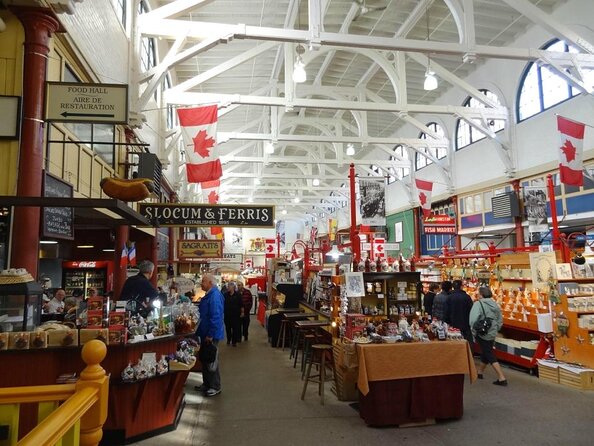
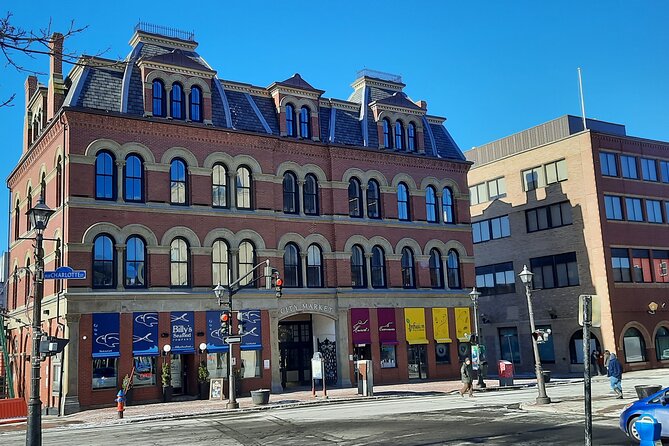
The City Market follows. Pete explains the building’s design and history, including its status as the oldest continuously operating market in Canada. You get a few extra minutes to shop, but this is not a full market visit.
That short browsing period is worth planning around. If you want to buy food, examine crafts, or take your time with the stalls, visit before or after the tour. The guided portion gives you useful context, but the schedule does not leave room for a long wander.
Charlotte Street murals and the park at King’s Square
After the market, the route reaches Charlotte Street, where Pete points out large murals depicting famous Saint John people. These murals are down an alley, making them easy to miss if you are walking alone.
This is the sort of detail that makes the tour feel more personal. You are not only being taken to postcard landmarks. You are also shown pieces of local identity tucked into the streetscape.
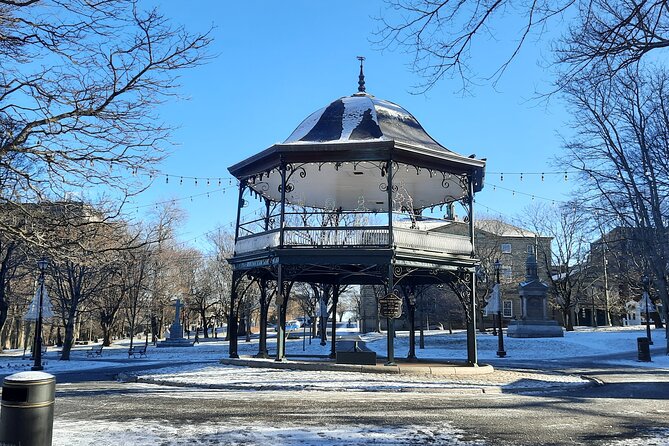
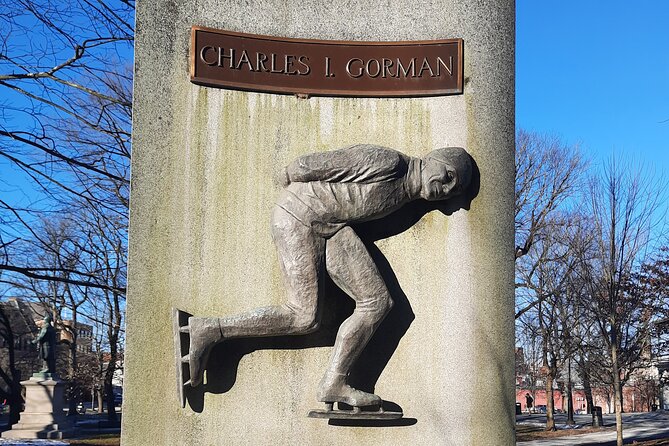
King’s Square provides one of the more substantial history stops. The park was established in 1785, and Pete points out its main features, including a mass of molten metal left by the Great Fire, the William Young statue, the Charles Gorman statue, and the King Edward VII Bandstand.
The molten metal is especially effective as a physical reminder of the fire. Dates can blur, but an object changed by intense heat makes the event easier to picture. The bandstand and statues add another layer, showing how the park served civic and public life over time.
The route then crosses King Square South Street to the Irving Oil home office. Pete traces the Irving family’s New Brunswick story back to K.C. Irving in 1899. The stop is only about five minutes, but it adds business and industry to the tour’s portrait of Saint John.
More walking tours in Canada:
- Quebec City Walking Tour
★ 5.0 · 4,716 reviews - Old Quebec City: Grand Walking Tour with Private Option
★ 4.8 · 2,609 reviews - The Original Old Montréal Walking Tour by Guidatour
★ 4.5 · 2,217 reviews - Old Montreal Small-Group Walking Tour | Max 10 | by MTL Detours
★ 5.0 · 2,088 reviews
The Imperial Theatre and Admiral Beatty
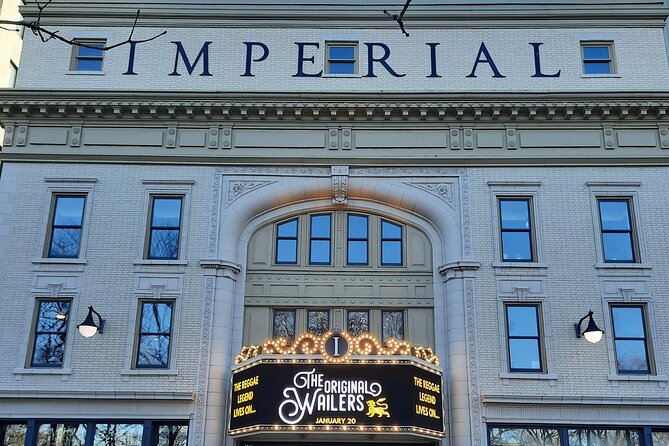
The Imperial Theatre gives Pete a chance to explain the city’s entertainment history. The building began as a vaudeville theatre in 1913. He points out the chandeliers and other architectural features, along with the theatre’s past and restoration.
This stop works best for people who enjoy buildings as evidence of changing city life. A theatre tells you what people did for entertainment, how they spent money, and what Saint John considered important enough to preserve.
Beside the theatre is the Admiral Beatty building. Pete explains how it began as a luxury hotel in 1925 and notes famous visitors, including Amelia Earhart before her transatlantic flight.
The pair of stops gives you a useful contrast. The Imperial Theatre represents public performance and culture, while the former hotel points to travel, status, and Saint John’s place in larger Atlantic routes. Pete’s use of visual material and specific names helps keep the buildings from becoming a blur of old facades.
Trinity Church and the Loyalist story

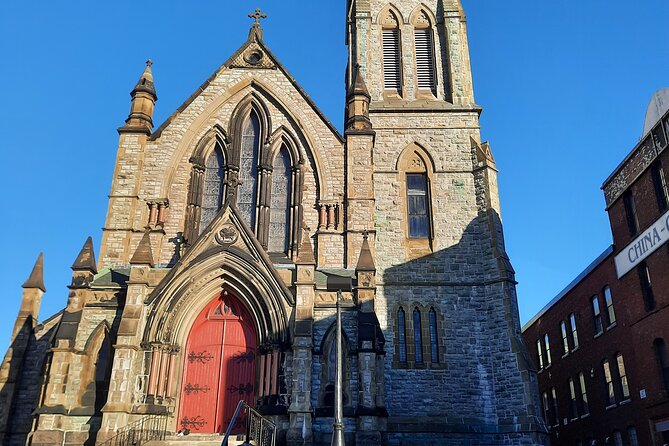
Trinity Church is one of the key historical stops. Pete describes the architecture and history of this Loyalist church and explains four main artifacts held inside.
The word Loyalist has already appeared earlier at the landing site, but Trinity Church gives it a more tangible setting. You can connect settlement, religion, civic organization, and the physical buildings that survived into the present.
The stop lasts about 15 minutes. That allows time for a proper explanation, though the exact interior access and viewing conditions can depend on church operations and the day’s circumstances. The tour information identifies the church and its artifacts, but it does not promise a formal interior visit, so keep your expectations focused on interpretation rather than a private church tour.
After leaving Trinity Church, you walk along Germain Street. Pete explains that it was named for Lord George Germain and discusses the Union Club, a business club dating from 1884. The stop is brief, yet it helps explain the social and commercial networks that shaped the city.
Princess Street and the old Wall Street of Canada
At the corner of Germain and Princess Streets, Pete points out how a newer building was designed to fit preservation standards. Next comes the historic Ritchie building, with attention to its notable features.
This is a valuable lesson in urban preservation. You see that protecting an old district does not mean freezing every building in time. New construction can still respect the scale and character of the streets around it.
The route turns downhill on Princess Street and reaches Prince William Street, once known as the Wall Street of Canada. Pete points out Chubb’s Corner with its carved stone heads, old City Hall, the former post office, the Jarvis building, the Bank of New Brunswick Palatine building, and the Seamen’s Mission.
This is probably the densest architectural section of the walk. You move from one building to the next, but the real experience comes from learning how banking, government, shipping, and trade once worked together here.
Across from the Seamen’s Mission is a mural about Partridge Island. Pete explains the island’s role in immigration and quarantine, with particular attention to Irish arrivals during the Potato Famine.
That story gives the waterfront a human dimension. Saint John was not only a place of ships and commerce. It was also a point of arrival, illness, hardship, and hope. The mural makes a complicated subject easier to approach in the middle of a city walk.
Three Sisters Lamp and the modern waterfront
At the foot of Prince William Street, the tour reaches the Three Sisters Lamp in St. Patrick Park. Pete explains why the lamps have that name and how they helped save lives.
It is a short stop, about five minutes, but it brings the route back toward the harbor. The lamps connect public infrastructure with the practical dangers of a port city. Small objects can carry surprisingly large stories, which is one of the pleasures of this tour.
The final scheduled point is the Marco Polo cruise terminal and Area 506 Waterfront Container Village. Pete explains how Saint John’s cruise industry began and how the waterfront has developed.
This ending links the city’s older maritime past with its present role as a port destination. You finish with a clearer idea of why cruise ships call here and how the waterfront continues to change.
The meeting information says the activity ends back at the meeting point, while the described route finishes at the cruise terminal area. Since those points are not identical, confirm the exact end arrangement when booking, especially if you have a ship departure, meal reservation, or limited time in port.
Pace, hills, group size, and practical comfort
The walk lasts about two hours and 30 minutes. It is described as easy by many people who took it, with frequent pauses to sit and listen. The route can use Saint John’s pedway system, escalators, and an elevator, which helps avoid the steepest hill sections.
Still, an easy walking tour is not the same as a seated sightseeing ride. You should have a moderate level of fitness and be ready to stand outdoors at several locations. One person found the amount of talking made the tour feel long, while others appreciated the steady stream of stories. Your ideal experience depends on whether you prefer detailed narration or more time to roam independently.
The maximum group size is 20. That is small enough for a more personal feel, and clear speaking is repeatedly emphasized. Morning and afternoon departures make it easier to fit the walk around a cruise schedule or other plans.
Service animals are allowed, and pet dogs are welcome. The tour is described as accessible, and one person using a wheelchair was accommodated. Special-needs children are free. Since weather can affect the route, bring suitable clothing and check conditions before setting out.
Is $33.80 a fair price?
At $33.80 per person, this tour offers good value if you want a guided introduction to Saint John rather than a quick list of landmarks. You receive 150 minutes with a local guide, historical explanation at 15 stops, rare photo copies, and personal stories tied to the city’s past and present.
The price is especially fair for a small group. You are not paying for transportation, lunch, or admission tickets, but the route itself is built around public streets, parks, and exterior views. The cost goes toward Pete’s time, preparation, storytelling, and local perspective.
The value drops if you mainly want market shopping or uninterrupted sightseeing. The market stop is short, and several locations involve standing while Pete explains details. If you enjoy asking questions, learning why buildings matter, and getting local restaurant suggestions, the price makes more sense.
You can cancel for a full refund up to 24 hours before the start time. Changes made inside that window are not accepted, and poor weather can lead to a new date or full refund.
Who should book Pete’s Historic Walking Tour?
I would choose this tour if you are visiting Saint John for the first time, arriving by cruise ship, or trying to understand the city before exploring on your own. It suits history fans, curious solo visitors, couples, families, and anyone who prefers a personable local guide over an audio recording.
It is also a good pick if steep streets worry you. The pedways and lifts can make the route easier, though you should still be comfortable with a couple of hours of city walking and outdoor stops.
I would think twice if you want a fast-paced route with lots of free time. The experience includes substantial narration about Pete’s Pub, the Marco Polo model, the theatre, the old buildings, immigration, and local figures. Those sections are central to the tour, not filler to be skipped.
FAQ
How long is Pete’s Historic Walking Tour?
The tour lasts approximately two hours and 30 minutes.
How much does the tour cost?
The price is $33.80 per person.
Where does the tour start?
The meeting point is Duke Street and Water Street in Saint John, New Brunswick.
What language is the tour offered in?
The tour is offered in English.
Are morning and afternoon times available?
Yes. You can choose from morning and afternoon tour times.
Is the tour suitable for people with limited mobility?
The tour is described as accessible and may use pedways, escalators, and an elevator to avoid steep hills. A moderate level of physical fitness is still recommended. Service animals are allowed, pet dogs are welcome, and special-needs children are free.
Should you book it?
Book Pete’s Historic Walking Tour if you want Saint John explained by someone who knows its streets, stories, businesses, and characters. Pete’s humor, clear voice, personal background, and use of old photographs give the tour more personality than a basic architecture walk.
Skip it if your priority is shopping at the market, covering a wide area quickly, or spending most of the time moving rather than listening. For everyone else, $33.80 buys an easy-paced introduction to Saint John, from the Loyalist Landing and Great Fire to Irish immigration, grand old buildings, and today’s cruise waterfront. That is a useful foundation for the rest of your visit.
Newest reviews from Canada
- YQB Airport Transfer★ 5.0 · 41 reviews
- Salish Sea Horse-Drawn Carriage Tour of Victoria★ 4.5 · 41 reviews
- Banff: Sightseeing, Lake Minnewanka Cruise and Banff Gondola★ 4.7 · 41 reviews
- Private Guided Rainforest Hike in Victoria★ 5.0 · 41 reviews
- Fly over the City of Ottawa in a Helicopter★ 5.0 · 41 reviews
- Kicking Horse River: Whitewater Rafting Experience★ 4.9 · 41 reviews
- Niagara Falls, Canada: Whirlpool Adventure Ropes Course★ 4.7 · 41 reviews
- Chinatown and Hidden Alleys Pedicab Tour★ 5.0 · 42 reviews
Saint John New Brunswick Tours, compared.




From Saint John: Bay of Fundy Bus Trip for Cruise Passengers
Read our review →
Best of Saint John Small Group Tour w/Fort La Tour + Martello
Read our review →Browse the lists this tour appears in