
Reviewed · OTTAWA TOURS
Ottawa’s Hidden History: A Self-Guided Audio Tour
Ottawa rewards curious walkers. This $8.99 GPS audio tour links Colonel John By, the Rideau Canal, ByWard Market, and Ottawa’s early hospitals and schools in about an hour. I like the freedom to pause whenever you want, and I like that the route uses real streets and public spaces rather than keeping you inside a museum. The main drawback is technical: finding the exact starting point and getting the app to begin may take patience.
The walk covers roughly 50 minutes to 1 hour 10 minutes, with no guide or group to follow. You bring your own phone and headphones, then use offline audio, maps, and location data. That makes this a good low-cost choice for independent visitors, but less appealing if you want personal conversation or a perfectly smooth introduction.
In This Review
- Key points before you set out
- Why this short Ottawa walk works
- Beginning at Major’s Hill Park
- The Rideau Canal and Ottawa’s first big project
- Walking down York Street and the York Steps
- The Millennium Fountain and Ottawa’s changing identity
- ByWard Market, the liveliest stop on the route
- Rochon House and the early lumber economy
- Élisabeth Bruyère and Ottawa’s first hospital
- LaSalle Academy and the city’s intellectual life
- Finishing near Sussex Drive and Notre Dame Basilica
- App performance, headphones, and route planning
- Price, timing, and who gets the best value
- Should you book Ottawa’s Hidden History?
- FAQ
- How much does the Ottawa audio tour cost?
- How long does the tour take?
- Where does the tour start?
- Where does the tour finish?
- Is the tour guided in person?
- What language is available?
- Do I need to bring my own equipment?
- Does the tour work offline?
- Can I use the tour after my booking date?
- Can I cancel for a refund?
Key points before you set out
- Start beside Colonel John By’s statue: Major’s Hill Park gives the tour an attractive beginning and connects directly to Ottawa’s canal story.
- Follow Ottawa’s early development: York Street, the York Steps, Rochon House, and ByWard Market reveal how Bytown grew.
- See the Rideau Canal in context: The UNESCO World Heritage Site is not just scenery here, but the key piece of Ottawa’s early engineering story.
- Use the app at your own pace: You receive lifetime access, offline maps, and virtual playback, so you can listen from anywhere.
- Expect a route through public places: There are no included admissions, meals, transportation, or headphones.
- Allow extra time at the start: One user found the exact point in Major’s Hill Park difficult to locate, and another had trouble starting the app.
Why this short Ottawa walk works
Ottawa’s center can feel scattered at first. Parliament Hill, the canal, ByWard Market, Sussex Drive, and Major’s Hill Park each attract attention, but the connections between them are easy to miss. This audio tour gives those places a simple thread: the development of Bytown and the people who helped turn it into Ottawa.
I like the price. At $8.99 per person, the tour costs less than many guided city walks, yet it gives you a planned route and spoken context. The value is strongest if you want a quick orientation and prefer to stop for photographs, food, or a closer look without holding up a group.
The format also suits repeat visitors. You have unlimited, lifetime use before and after your booking date, along with a virtual playback option. You can listen from somewhere else like an audiobook, though the route makes the most sense when you are actually walking through central Ottawa.
The experience is offered in English only. It is a private activity for your own group, with no shared departure time. You can begin during the listed opening period, which runs every day from April 10, 2024, through February 7, 2027.
More historical tours in Ottawa:
- Gatineau: Canadian Museum of History Admission
★ 4.8 · 230 reviews - Ottawa : Historic Tour of the Ottawa Jail Hostel
★ 4.7 · 78 reviews - Ottawa’s Original Historical Highlights Public Walking Tour
★ 5.0 · 17 reviews
Beginning at Major’s Hill Park
The tour starts at Major’s Hill Park on Mackenzie Avenue, close to the Ottawa River and central Ottawa sights. The park is a sensible opening point because it gives you room to get oriented before you move into the city streets.
Your first stop is the statue of Colonel John By. He was the visionary behind the Rideau Canal, and the statue looks out over the river. The audio introduction places him at the beginning of Ottawa’s story, rather than treating the canal as an isolated engineering attraction.
Give yourself a few extra minutes here. The precise start point is somewhere in the park, not simply at a large building with an obvious sign. One person found the hardest part was locating the exact spot and had to watch the distance readout on the phone. That is useful advice: arrive early, keep the app open, and use the GPS indicator carefully.
The park also offers broad views toward the Ottawa River and Parliament Hill. You may want to pause before starting the narration, especially if you are carrying luggage, traveling with children, or arriving after a busy day.
The Rideau Canal and Ottawa’s first big project
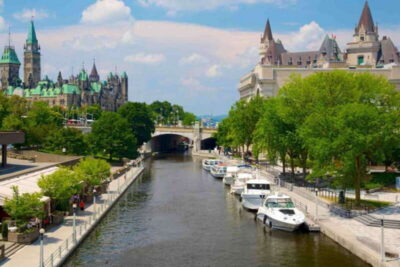
From Major’s Hill Park, the route passes the Rideau Canal. The canal is a UNESCO World Heritage Site and one of Ottawa’s most important pieces of 19th-century engineering. It links Ottawa with Lake Ontario, and the tour explains why that connection mattered to the city’s growth.
The canal is often photographed as a pretty strip of water, but the audio gives it a practical purpose. Its construction helped shape the settlement that became Ottawa. Hearing that story while you are near the locks makes the setting easier to understand than a detached museum display would.
The route includes Rideau Canal Locks 1 through 8 in the broader ending area. The walk does not include transportation or admission fees, so you should plan to explore only the public areas unless you separately choose to visit a paid site.
Major’s Hill Park returns as part of the early route, this time as more than a starting marker. Its views of Parliament Hill and the river give you a visual pause between the canal story and the older streets of Bytown.
Walking down York Street and the York Steps
The route then turns toward York Street, one of the places where Ottawa’s early development becomes easier to picture. You pass the York Steps, which played a part in the early growth of Bytown.
This section should appeal to you if you like city history at street level. Instead of looking only at major monuments, the tour points to a route used during the settlement’s formative years. The steps and street help connect the canal project with the daily movement of people through the young town.
The audio format is useful here because there may be little formal interpretation at every point. You can stand near the York Steps, listen, and then continue when you are ready. The tradeoff is that the experience depends on your phone’s location and your attention to the route.
A GPS walk is not the same as an escorted tour. You will need to keep an eye on the map, especially at turns. If you tend to walk quickly, pause often, or stop for photographs, the flexible format is a benefit. If you would rather simply follow a guide without checking your screen, it may feel less comfortable.
More self-guided routes in Ottawa:
- Self-Guided Biking in Ottawa-Gatineau
★ 5.0 · 107 reviews - Ottawa: 4 or 8-Hour Bike Rental with Self-Guided Tour
★ 4.7 · 51 reviews - Cycling Ottawa’s 200th Anniversary, self-guided
★ 5.0 · 45 reviews - Street Art Exploration Game and Self-Guided Tour in Ottawa
★ 4.0 · 20 reviews
The Millennium Fountain and Ottawa’s changing identity
York Street also brings you past the York Street Millennium Fountain. This modern landmark represents Ottawa’s continuing change and progress, giving the route a useful shift in time.
The fountain matters because the tour is not limited to old stone buildings and early settlement stories. Ottawa is presented as a city that continues to develop, with newer public features sitting beside historic streets. That contrast helps prevent the walk from becoming a string of dates and names.
I appreciate this kind of stop on a short tour. It gives you a visual marker and a reminder that history is not sealed away in the past. You move from Colonel John By and Bytown to a more modern Ottawa without needing a separate section of the city.
The tour remains outdoors and self-guided. There is no stated admission cost for the fountain or the public route, but personal expenses are not included if you decide to stop elsewhere along the way.
ByWard Market, the liveliest stop on the route
ByWard Market is likely to be the most active part of the walk. It is one of Canada’s oldest and largest public markets, with vendors, restaurants, and artisans. The route uses the market to explain Ottawa’s commercial and social development.
This is where the tour becomes especially practical for first-time visitors. You are not only hearing about an old market. You are also arriving in an area where you can pause for a meal, browse stalls, or continue directly through the route.
The market can be busy, so keep your headphones at a volume that lets you stay aware of your surroundings. The audio may be easy to hear in a quiet park, but streets and market activity can make listening more demanding. You can pause the tour whenever you like and restart it after looking around.
The market is also a natural place to extend the outing. The official audio portion is under 90 minutes, but your full visit may take longer if you stop for food or shopping. That is one reason the lifetime access matters. You do not need to force every stop into a single fast walk.
Rochon House and the early lumber economy
After ByWard Market, the tour brings you to Rochon House. This historic building has links to Ottawa’s early lumber industry and cultural heritage.
Rochon House adds an important economic layer to the route. The canal explains engineering and transport, while the market shows trade and public life. Rochon House points toward the industries that helped the young settlement grow.
I like this stop because it broadens the story beyond government buildings. Ottawa is often presented through Parliament, national institutions, and grand public architecture. A house connected with the lumber industry helps you see the working economy behind the city’s growth.
The information provided does not indicate that you enter Rochon House or pay an admission fee. Treat it as an exterior stop on the walking route, and check the app for the exact listening point when you arrive.
Élisabeth Bruyère and Ottawa’s first hospital
The next stop introduces Élisabeth Bruyère, who founded Ottawa’s first hospital to serve local healthcare needs. Her contribution brings a human and social side to the tour.
This is a worthwhile change of subject after canals, markets, and industry. You hear about the people who needed care and the person who helped create an institution for them. It also shows that Ottawa’s development involved more than transport and commerce.
The stop may appeal most to you if you enjoy social history. It is a reminder that a growing town needs hospitals, schools, and community services as much as it needs roads and markets.
As with the other points, the tour does not list an included admission or a guided interior visit. You are listening while walking through the city, using the location-based audio to place Bruyère’s work within Ottawa’s early story.
LaSalle Academy and the city’s intellectual life
The route passes LaSalle Academy, a historic educational institution that contributed to Ottawa’s intellectual and cultural development. This stop completes the tour’s look at the basic systems of a growing city: transport, trade, healthcare, and education.
LaSalle Academy is not treated as a detached school building. It becomes part of the larger story of how Ottawa developed a civic identity. After hearing about the canal and lumber industry, you get a chance to consider how education helped shape the city’s cultural life.
The tour’s sequence is one of its strongest features. It does not simply send you from one famous photo stop to another. It moves through different parts of early Ottawa and shows how several institutions supported the settlement.
You should keep your expectations realistic. The experience lasts about 50 minutes to 1 hour 10 minutes, so each stop receives a concise explanation rather than a long lecture. If you want detailed architectural history or extended commentary on every building, you will need another source as well.
Finishing near Sussex Drive and Notre Dame Basilica
The route finishes in the Sussex Drive area, near Notre Dame Cathedral Basilica. The basilica is a major example of Gothic Revival architecture and gives the walk a strong architectural and religious closing point.
The stated ending information also places the final area around the Rideau Canal, locks 1 through 8, ByWard Market, and Parliament Hill, with the tour ending at Sapper’s Bridge. Use the app’s live directions for the exact finish, since the route description refers to both Sussex Drive and Sapper’s Bridge.
Notre Dame Basilica works well as a final stop because it shifts the focus toward religious heritage and formal architecture. After streets tied to Bytown’s early development, you finish near one of Ottawa’s more imposing historic buildings.
The tour does not include entrance fees, and the supplied information does not promise an interior visit. Plan to view the basilica from the route unless you separately confirm access and any cost.
App performance, headphones, and route planning
The biggest practical question is not the history. It is whether the app works smoothly on your phone.
The tour includes offline audio, maps, and geodata. That is useful if your mobile connection is weak or you want to avoid using much data. Download or prepare the tour before you begin, and bring fully charged devices. You also need your own smartphone and headphones.
The feedback is mixed. One person found the app easy once the starting location was found. Another said the app was not intuitive and would not start, calling the experience frustrating. VoiceMap support can be contacted by phone or email for technical problems, and the provider says it can troubleshoot issues and process a refund if you email [email protected] with your details.
That support option is worth knowing before you set out. I would not wait until you are halfway through the route to check whether the audio loads. Confirm that the tour opens, test the playback, and make sure location services are available.
The virtual playback feature is a useful backup. You can listen from anywhere, even though the best use of the tour is walking the route in Ottawa.
Price, timing, and who gets the best value
At $8.99 per person, this is a modest purchase. You are paying for a prepared route, narration, maps, GPS positioning, offline access, and lifetime use rather than for a live guide.
I see the strongest value for:
- Independent visitors who enjoy exploring without a fixed schedule
- First-time visitors who want a quick introduction to central Ottawa
- Repeat visitors looking for a different way to connect familiar sights
- Couples or private groups who do not want to join strangers
- People who like to pause for photographs, food, or market browsing
It is less suitable if you want a live guide, detailed questions answered on the spot, or a fully managed experience. It also may not suit someone who dislikes phone navigation or has unreliable access to a smartphone.
The tour is listed as suitable for most participants, and service animals are allowed. It is near public transportation, though transportation itself is not included. Free cancellation is available up to 24 hours before the start time. Inside that window, the payment is not refunded, and changes are not accepted.
Should you book Ottawa’s Hidden History?
Book it if you want a cheap, flexible introduction to Ottawa that connects the Rideau Canal with Bytown’s streets, ByWard Market, Rochon House, Élisabeth Bruyère, LaSalle Academy, and Notre Dame Basilica.
I would treat the exact start point and app setup as part of the preparation. Arrive early at Major’s Hill Park, use the distance readout, bring headphones, and contact VoiceMap support promptly if playback fails.
Skip it if you want a personal guide or a long, highly detailed history lesson. For independent walkers who value freedom and a clear route, $8.99 is a fair price for a short tour with useful context and lifetime access.
FAQ
How much does the Ottawa audio tour cost?
The tour costs $8.99 per person.
How long does the tour take?
The estimated duration is about 50 minutes to 1 hour 10 minutes.
Where does the tour start?
It starts at Major’s Hill Park on Mackenzie Avenue, Ottawa, Ontario K1N 1G8.
Where does the tour finish?
The route finishes in the Sussex Drive and Rideau Canal area. The ending information identifies Sapper’s Bridge as the final point.
Is the tour guided in person?
No. It is a self-guided GPS audio tour for your private group.
What language is available?
The tour is offered in English.
Do I need to bring my own equipment?
Yes. You need your own smartphone and headphones.
Does the tour work offline?
Yes. Offline access includes the audio, maps, and geodata.
Can I use the tour after my booking date?
Yes. The tour includes unlimited lifetime use before and after the booking date.
Can I cancel for a refund?
Yes. You can cancel at least 24 hours before the local start time for a full refund. Cancellations or changes made within 24 hours are not accepted for a refund.
More Audio Tours
- Icefields Parkway: a Smartphone Audio Driving Tour
★ 4.0 · 118 reviews - Cabot Trail: a Smartphone Audio Driving Tour
★ 4.5 · 118 reviews - Niagara: Behind The Falls, Skylon Tower Ticket & Tesla Audio Tour
★ 3.5 · 69 reviews - Sea to Sky Highway: a Smartphone Audio Driving Tour
★ 4.0 · 32 reviews
Newest reviews from Ottawa
- Sunset Kayak Tour in Downtown Ottawa and Gatineau★ 5.0 · 6 reviews
- Haunted Walk at Beechwood Cemetery National Historic Site★ 4.5 · 6 reviews
- Pontiac Farm Tour – Day Trip From Ottawa & Gatineau★ 5.0 · 6 reviews
- Ottawa: Most Unique Poutine Tour★ 5.0 · 6 reviews
- Full-Day Montreal City Tour from Ottawa and optional city cruise★ 4.5 · 7 reviews
- Ottawa: Panoramic helicopter flight (Gatineau Park + downtown)★ 5.0 · 7 reviews
- Ottawa: Downtown Yacht Cruise – Wed-Sun @ 6PM – 75 Minutes★ 4.4 · 8 reviews
- Hidden Ottawa Secrets Walking Tour★ 4.5 · 8 reviews
Ottawa Tours, compared.




Browse the lists this tour appears in