

Reviewed · QUEBEC CITY TOURS
Old Town Quebec Secrets: Private Exploration Game and Tour
Old Quebec rewards curious walkers. This private game turns its streets into a history puzzle, leading you from the Tourny Fountain and Saint-Louis Gate to Place Royale while asking you to study what is around you. I like the mix of sightseeing and riddles, and I like that you can play without mobile data or an internet connection. The main catch is that a few clues may be outdated or unclear, so competitive puzzle fans should bring patience.
At about 90 minutes, this is a compact way to get your bearings in Québec City. You can begin and pause the game when it suits you, and the low price makes it easy to add to a family day. Still, this is not a guided walk with a person answering questions on the spot. Your phone and the Questo app do the leading.
In This Review
- Key points to know before you play
- How the Old Quebec game works
- The Tourny Fountain opens the story
- Saint-Louis Gate and the old city limits
- The cannonball in the elm tree
- The Ursuline convent and Montcalm’s burial place
- The Anglican cathedral outside Britain
- Place de l’Hôtel-de-Ville and the changing public square
- The Séminaire de Québec and the colony’s clergy
- Champlain, Chevré, and the city’s public memory
- Place Royale, the payoff at the lower town
- Price, group size, and the value of solving your own way
- Who should choose this Quebec City activity?
- Should you book Old Town Quebec Secrets?
- FAQ
- How long does Old Town Quebec Secrets take?
- Where does the game begin and end?
- Do I need internet or mobile data to play?
- Is a tour guide included?
- Can children join for free?
- What is the cancellation policy?
Key points to know before you play
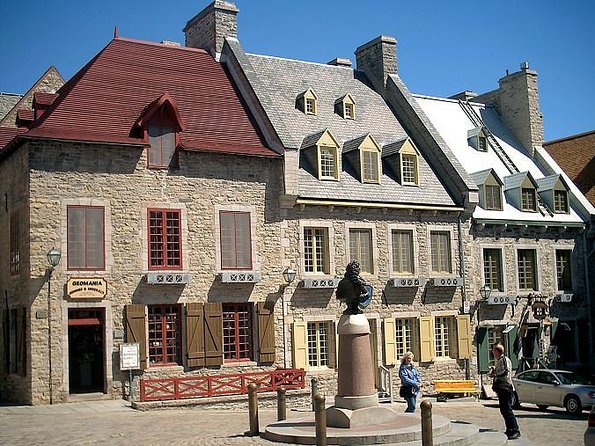
- Fourteen historic stops: The route connects major sights with smaller stories, including a cannonball caught in an elm tree and the old names of Place de l’Hôtel-de-Ville.
- Offline play: You do not need data or an internet connection once the game is ready to use.
- Private by design: Only your own group takes part, with no physical guide and no strangers joining you.
- Strong family appeal: Kids play free, and the riddles give younger visitors a reason to look closely at buildings and monuments.
- Flexible timing: Start anytime during the operating period, pause when you need a snack or photo, and continue later.
- A low-cost trial: At $9.29 per person, the activity costs less than many organized city tours, though technical or wording problems can reduce its value.
How the Old Quebec game works

This is a self-guided city game, not a standard walking tour. You follow step-by-step directions in the Questo app, reach a location, inspect the surroundings, and solve a challenge. A correct answer moves you onward and gives you the next piece of the story.
That format changes the way you walk through Old Quebec. Instead of passing the Tourny Fountain with a quick photo, you look for details. Instead of simply entering a square, you think about what it was called and why its name changed. I like that small shift. It gives you a job to do, and the city becomes your game board.
The experience begins at 3004 Av. Honoré-Mercier and guides you to Place Royale. The listed finish is on Rue des Pains Bénits in the lower part of Old Quebec. The route takes about an hour and a half, though your actual time may stretch if you pause for photographs, food, or extra sightseeing.
You can play any time after booking, within the stated operating period of Monday through Sunday, from midnight to 11:30 p.m. That broad window is useful in Québec City, where weather, meal times, and cruise schedules can change your plans. I would avoid treating the 90-minute estimate as a hard appointment. Build in room to stop and enjoy the places that interest you.
More Old Quebec walks:
- Old Quebec City: Grand Walking Tour with Private Option
★ 4.8 · 2,609 reviews - Old Quebec Classique Walking Tour with Funicular
★ 5.0 · 1,317 reviews - Old Quebec City Food Tour with 10+ Autentic Local Tastings
★ 5.0 · 1,288 reviews
The Tourny Fountain opens the story
The first challenge centers on the Tourny Fountain, a handsome landmark with an international past. French sculptor Mathurin Moreau designed the work in 1853, and six copies were made. The fountain was shown at the 1855 World’s Fair in Paris before one version found its place in Québec City.
The puzzle asks you to look around for an answer rather than simply read a paragraph on your screen. That is a good opening task because it gets you observing right away. You may need to examine the fountain itself and its setting instead of rushing toward the next stop.
I would give yourself a few minutes here. The fountain is easy to treat as decoration, but its story connects Québec City to nineteenth-century French art and international exhibitions. The app provides the prompt, while the physical place supplies the clues.
Saint-Louis Gate and the old city limits
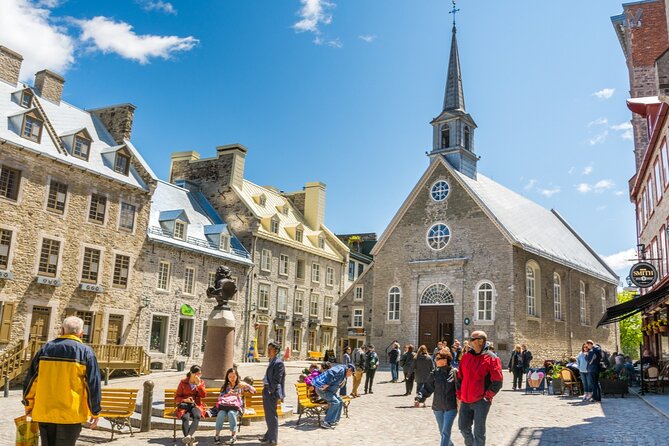
The route then moves to Saint-Louis Gate, whose first version was built in the late seventeenth century under French rule. During the British period, the military shut the gate doors at night to control movement between the city and the outlying areas.
That policy had practical consequences. It disrupted trade and made life harder for people who needed to travel in and out. The gate was not just an opening in a wall. It was a tool of control, and the challenge gives you a reason to consider how a city’s defenses affected ordinary business.
This is one of the more useful stops for understanding fortified Québec. You are not only looking at masonry and traffic. You are thinking about who could pass, when they could pass, and how military rules shaped the city’s growth.
The cannonball in the elm tree
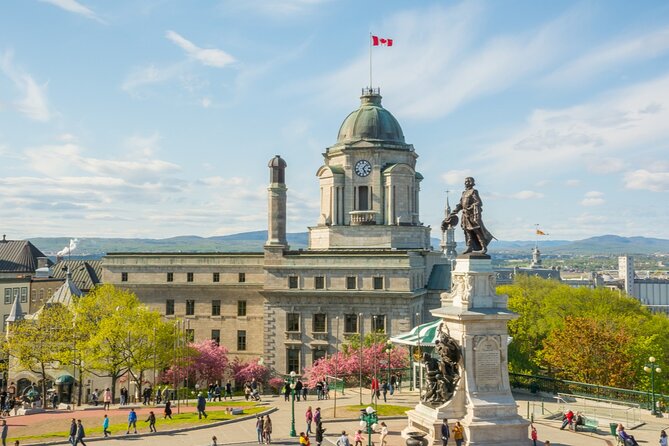
Old Quebec has no shortage of grand stories, but the old elm on Rue Saint-Louis offers a more curious one. At the corner of Rue du Corps-de-Garde, a large cannonball appears to be caught in the tree’s twisted roots.
Calèche drivers traditionally slow down to point it out. Passers-by stop to study the odd pairing of tree and iron. The game uses that curiosity as a challenge, asking you to look closely and work out the story connected with the cannonball.
This is exactly the kind of stop that makes a puzzle walk different from a formal lecture. You are sent toward a detail that could easily escape notice. I would not expect a grand monument or a long visit here. Its value is in the small mystery and the way it makes you inspect the street.
More self-guided routes:
- Old Quebec Scavenger Hunt and Highlights Self Guided Audio Tour
★ 4.0 · 8 reviews - Quebec City Old Town Private Self Guided Walking Tour
★ 4.5 · 7 reviews - Quebec City Self-Guided Driving Audio Tour
★ 4.0 · 7 reviews - Private Self-guided River Rafting Tour in Calgary
★ 5.0 · 182 reviews
The Ursuline convent and Montcalm’s burial place
The Couvent des Ursulines brings the route into the story of education and religion. Founded in 1639, it is the oldest institution of learning for women in North America. Its chapel is also connected to Louis-Joseph Montcalm, the French general who died after the 1759 battle that decided the fate of New France.
This stop packs several layers into a small area: women’s education, the work of a religious community, and the aftermath of war. The game does not ask you to memorize a long lecture. It gives you a question to solve, which may help you remember the place later.
I especially like this stop for families with older children. A simple question about a building can lead to a larger conversation about who received an education, how religious institutions worked, and why the Battle of the Plains of Abraham mattered. You may want extra time if you plan to visit more of the convent beyond the game route, though the supplied information does not promise interior access.
The Anglican cathedral outside Britain
The Cathedral of the Holy Trinity was built in 1804 and was the first Anglican church constructed outside Britain. It is now a National Historic Site of Canada, a designation granted in 1989.
The building uses a neoclassical Palladian design modeled after St Martin-in-the-Fields in Trafalgar Square. That detail gives the challenge a strong architectural angle. You are not simply looking for a name. You are comparing the church’s style and origins with the British influence that followed the change from French to British rule.
I would slow down here and look at the building’s form before opening the next prompt. The game works best when you give each stop a little attention. If you race from answer to answer, you may finish quickly but lose much of the visual reward.
Place de l’Hôtel-de-Ville and the changing public square
The public square near city hall has carried several names over time: Grande Place, Grande Place de la Haute Ville, and Place du Marché. In 1900, after city hall was built, it became known as Place de l’Hôtel-de-Ville. It was also called Place Notre-Dame and Place de la Basilique until the middle of the twentieth century.
This is a fine example of how a name can reveal a place’s changing purpose. A market square, a civic square, and a space linked to the basilica each suggest a different role. The challenge gives you a reason to notice those layers rather than treating the square as a generic open space.
You will likely be near several major sights here, so this is a sensible point to pause. The game can be stopped and resumed, which means you do not have to choose between solving the next clue and taking time for photographs or a short break.
The Séminaire de Québec and the colony’s clergy
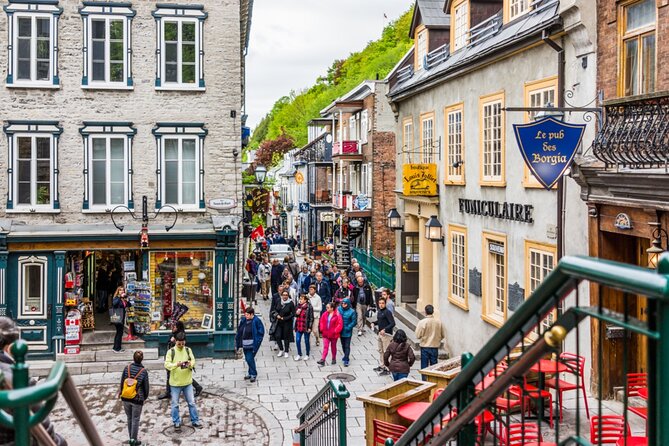
The Séminaire de Québec was founded in 1663 by François de Laval, who later became Québec’s first bishop. The society of Catholic priests trained clergy, worked to evangelize Indigenous people, and administered the colony’s parishes.
This stop helps explain how much responsibility the seminary carried in early Québec. It was not only a place for religious study. It helped organize the colony’s church structure and shaped relations with Indigenous communities.
I appreciate that the route includes institutions rather than only famous façades. You get a wider picture of how Québec developed. At the same time, the wording of the challenge matters. One direct criticism of this game is that some clues have been poorly phrased or made inaccurate by changes around the city. Use the hint system when needed, and do not let one stubborn answer spoil the entire walk.
Champlain, Chevré, and the city’s public memory
One monument on the route honors the founder of Québec City. Created by Paul Chevré, it was inaugurated in 1898. The stop offers a chance to think about how later generations chose to remember Samuel de Champlain and the city’s founding.
The game also introduces Jean-Paul Lemieux, one of Canada’s leading twentieth-century painters. Lemieux lived from 1904 to 1990 and worked in five different artistic periods. That is a welcome change of pace from military and religious history.
These two stops show the route’s range. One concerns a public monument and the memory of a founder. The other points to a Canadian artist and the changing ways a painter worked over a lifetime. You may not get a full art lesson, but you will encounter subjects that a basic old-city walk could easily skip.
Place Royale, the payoff at the lower town
The route’s final historic focus is Place Royale, described as the precise site where Samuel de Champlain built the first permanent French settlement in the Americas in 1608. His first habitation served as a fort, store, trading post, and residence. That combined role explains why Place Royale is often called the cradle of French North America.
This is a satisfying destination because the earlier stops have prepared you to see Québec as more than a pretty fortified town. Here, the story comes back to settlement, trade, defense, and daily life. You finish on Rue des Pains Bénits, in an area where you can continue exploring on your own.
The route also includes the Parliament Building, Québec City Hall, and Notre-Dame-de-Québec. The Parliament Building is an eight-floor structure designed by Eugène-Étienne Taché and built from 1877 to 1886. It houses Québec’s Parliament, including the Lieutenant-Governor and the National Assembly.
Québec City Hall opened on September 15, 1896. It slopes with the hill and occupied a site once associated with the Jesuit College and Jesuit Barracks, which stood there from the 1730s to 1878. City hall received National Historic Site status in 1984.
Notre-Dame-de-Québec has served as the first Catholic parish in North America since 1664. It became a cathedral in 1674 when it became the seat of the Diocese of Québec, and it became a basilica two centuries later. Shelling, fires, rebuilding, and renovations have all shaped the building you see today.
I would treat these final stops as anchors for the route. The app can point out the facts, but you should also lift your eyes and take in the scale and setting of the buildings. The combination of political, religious, and colonial stories gives the walk a useful sense of place.
Price, group size, and the value of solving your own way
At $9.29 per person, this is an inexpensive activity by Québec City standards. The value is strongest if you already enjoy riddles, architecture, and self-guided sightseeing. You get a private activity for your own group, and children are free, which can make the total cost especially attractive for families.
A group larger than 15 can make multiple bookings. That arrangement is practical, but it may be less tidy than joining a single organized group. Since no physical guide is included, you also save the cost of a guide while giving up personal explanations and live help.
The game has a published rating of 3.8 from 13 ratings, which fits the mixed picture. The best part is the combination of sightseeing, history, and puzzle solving. One family found it fun for the whole group, and another couple particularly enjoyed how it served different interests: architecture and sightseeing on one side, history and riddles on the other.
The weak point is reliability. A technical failure made the game unusable for one purchaser, and another found several clues outdated by more than a year because of construction or other city changes. That matters most if you are highly competitive. If you can accept a hint, a confusing question, or a clue that does not quite match the present street, the experience remains a useful way to explore.
Who should choose this Quebec City activity?
I would recommend it to families, couples, and friends who like having a purpose while they walk. It suits people who want to see Old Quebec but do not want a fixed group schedule. It also works well for visitors who have already seen the main streets and want a few lesser-noticed details, such as the cannonball in the elm.
Kids play free, and most people can participate. Service animals are allowed, and the route is near public transportation. The activity is offered in English.
I would be more cautious if you want detailed historical interpretation from a local guide. The app gives you facts and challenges, but it cannot respond like a person who knows your interests. I would also avoid making this your only planned activity if you dislike troubleshooting or expect every clue to be perfectly current.
You can cancel for a full refund if you do so at least 24 hours before the local start time. Changes or cancellations inside that window are not accepted for a refund. That policy is worth noting if your Québec City plans depend on weather or a changing schedule.
Should you book Old Town Quebec Secrets?
Book it if you want a low-cost private walk that combines Old Quebec’s major landmarks with small, surprising details. The offline play, flexible start, free admission for kids, and mix of architecture, art, religion, and politics give it real value.
Skip it if you want a polished guided tour with no technical risk and no unclear clues. My practical advice is to play with a charged phone, allow more than 90 minutes, and use hints when the wording seems wrong. For a family or puzzle-loving couple, $9.29 buys a lively introduction to the city. For a history specialist, it works better as an add-on than as a complete lesson in Québec City.
FAQ
How long does Old Town Quebec Secrets take?
The game takes approximately 1 hour and 30 minutes. You can pause it and continue later, so your total outing can be longer if you stop for photos, meals, or sightseeing.
Where does the game begin and end?
It begins at 3004 Av. Honoré-Mercier in Québec City. The Questo app provides step-by-step directions to Place Royale, and the listed ending point is Rue des Pains Bénits.
Do I need internet or mobile data to play?
No. The game is designed to be played offline, without a data connection or internet access.
Is a tour guide included?
No physical tour guide is included. The Questo app directs you from stop to stop and provides the challenges and information.
Can children join for free?
Yes. Children can play for free.
What is the cancellation policy?
You can receive a full refund if you cancel at least 24 hours before the experience’s local start time. Cancellations or changes made less than 24 hours in advance are not refunded or accepted.
Newest reviews from Quebec City
- Quebec City: Electric Bike Tour★ 4.7 · 6 reviews
- Heritage Upper Town E-Bike Tour★ 5.0 · 6 reviews
- Private tour of Quebec City 4 hours★ 5.0 · 6 reviews
- Guided cruise to discover Orleans Island and Quebec City★ 4.6 · 6 reviews
- Quebec City Scenic Walking Tour with 1 Funicular Ride★ 4.5 · 7 reviews
- Quebec City Old Town Private Self Guided Walking Tour★ 4.5 · 7 reviews
- Quebec: Christmas Interactive Walking Tour of New France★ 4.3 · 7 reviews
- Quebec City Self-Guided Driving Audio Tour★ 4.0 · 7 reviews
Quebec City Tours, compared.


Half-Day Trip to Montmorency Falls and Ste-Anne-de-Beaupré from Quebec city
Read our review →
Old Quebec City: Grand Walking Tour with Private Option
Read our review →
Montmorency Falls & Ile d’Orleans Half-Day Tour
Read our review →
Hop-on Hop-off Open-Top Double Decker Bus Tour
Read our review →Browse the lists this tour appears in