
Reviewed · QUEBEC CITY TOURS
Old Québec & French Canada Private History Walking Tour
Quebec City tells two national stories. This private 2.5-hour walk connects French settlement, British rule, the American invasion of 1775, and modern Canada in one clear route through Upper and Lower Town. I like the way guide Michel Perron links Quebec events to American history, and I like that the tour is private, so your group can ask questions and set the pace.
The tour also covers a remarkable number of major sites, from the Plains of Abraham and the ramparts to Place Royale and the Petit-Champlain stairs. The main consideration is physical: you walk about a mile through hilly streets and stairways, and two and a half hours can feel full if you prefer a slow, stop-for-everything visit.
In This Review
- Key points at a glance
- Why this private walk works so well
- Starting with Quebec’s military story
- Château Frontenac and the making of modern Canada
- Dufferin Terrace above Forts and Châteaux Saint-Louis
- British Quebec, the Citadel, and the American threat
- The Plains of Abraham and the French defeat
- Walking the walls around Old Quebec
- Parliament and the French Catholic institutions
- Notre-Dame, the Seminary, and French America
- Upper Town, Lower Town, and the city’s two levels
- The Price Building and Quebec’s changing economy
- Place Royale, the birthplace of Canada
- Petit-Champlain and the Old Port
- The 1775 invasion and the Old Financial District
- What the $213.92 group price gets you
- Who should book this Quebec City walk?
- Should you book it?
- FAQ
- How long is the Old Québec and French Canada Private History Walking Tour?
- How much does the tour cost?
- Is the tour private?
- Is hotel pickup available?
- What language is the tour offered in?
- How much walking is involved?
- Does the tour include museum admission?
- Are service animals allowed?
- Can I cancel for a full refund?
Key points at a glance
- A private group tour for up to 10 people: The $213.92 group price can be strong value for a larger family or friend group.
- French and American history together: You get a Canadian view of the 1775 to 1776 invasion, the French and Indian War, and the Treaty of Paris.
- Upper and Lower Town in one route: The walk covers the fortified city, Place Royale, Petit-Champlain, and the Old Port.
- Michel Perron brings visual aids: Maps, timelines, and historical images help make complicated events easier to follow.
- A useful first-day orientation: The tour gives you a working map of Quebec City before you explore on your own.
- A real walking tour: Expect hills, stairs, and a moderate fitness requirement rather than a gentle stroll on flat ground.
Why this private walk works so well
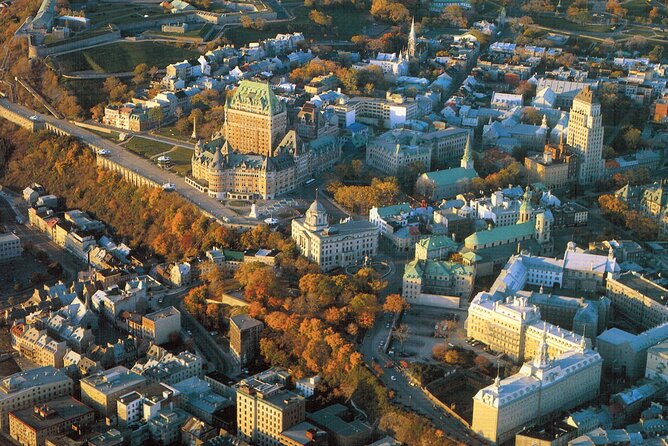
Quebec City is compact, but its story is not. One street may point to French Catholic power, British military control, American attack, and modern Canadian identity within a few minutes of walking.
That is where a private guide earns the fee. Instead of hearing disconnected facts at isolated monuments, you can ask why the city was built here, why it mattered to France and Britain, and how its location on the St. Lawrence River shaped the continent.
The tour is offered in English, with guiding services included. If you stay in Old Quebec, the guide meets you in your hotel lobby five minutes before the start. If you stay elsewhere, the provider contacts you with an easy meeting point.
The group limit is 10. That matters. A family with children can ask for simpler explanations, while a history-minded group can spend more time on the 1775 invasion or the French and British fortifications.
The experience has a 5.0 rating from 41 reviews, and every rating is positive. The strongest praise centers on the guides’ preparation, warmth, flexibility, and ability to explain difficult history in a way that works for both adults and children.
More Historical Tours in Quebec City
- Evening Gourmet Tour 5 Course Dinner – History and Food in Old Quebec City
★ 5.0 · 496 reviews - Quebec City: Old Quebec Historical Walking Tour
★ 4.8 · 409 reviews - Combo Historical and Food Tour of Old Quebec
★ 5.0 · 360 reviews
Starting with Quebec’s military story
The route begins with Canada’s military past and the great battles fought around Quebec City, from the first French settlers through 1776. This is a smart opening because Quebec was never just a pretty old town. It was a military prize guarding the St. Lawrence route into the continent.
You may see a museum devoted to Canadian military history and the battles of Quebec City. The subject helps set up the rest of the walk: French settlement, the French and Indian War, the British conquest, and the failed American invasion.
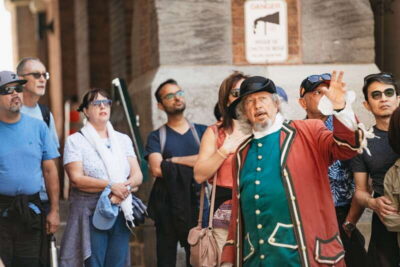
Guide Michel Perron is especially well suited to this part of the tour. He uses maps, timelines, and historical photographs carried in his backpack. Those tools are useful here because the names, alliances, and dates can otherwise blur together.
Château Frontenac and the making of modern Canada
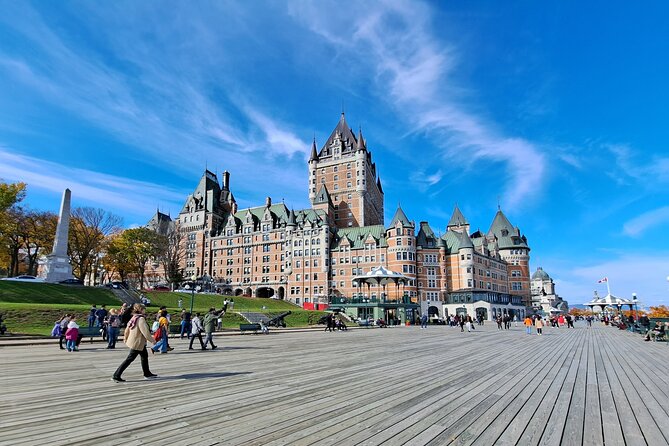
The Fairmont Château Frontenac is one of the city’s most recognizable buildings. It opened in 1893 as a Canadian Pacific Railway hotel, part of the railway era that helped tie Canada together from coast to coast.
You will not only be looking at a grand hotel. You will also be seeing a symbol of modern Canada, built when rail travel was shaping the country’s identity and economy.
The hotel is a good place to pause and look beyond the postcard view. The tour places the building within Canadian development, rather than treating it as a pretty piece of architecture with no wider story.
Dufferin Terrace above Forts and Châteaux Saint-Louis
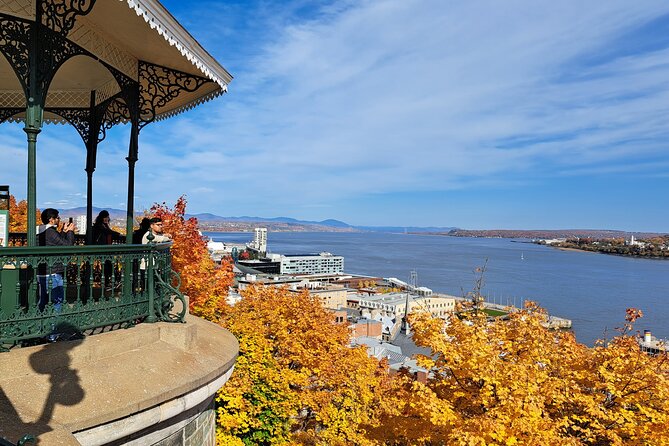
The boardwalk near Château Frontenac recalls the British royal family and its representatives in Canada. It was built during the development of modern Canada and now gives you one of the city’s most memorable viewpoints.
Below the boardwalk lies the Forts and Châteaux Saint-Louis National Historic Site. The castle and fort complex served as the residence of French governors until the French and Indian War. Much of that earlier world is now beneath the terrace.
This is a fine example of how Quebec City rewards a guide. You can look at the busy boardwalk while picturing the administrative center that once operated below it. The visible city and the buried city are both part of the same stop.
Nearby, a war monument recalls the French and Indian War in Canada. The monument helps connect the governor’s residence, the military conflict, and the change in power that followed.
More Walking Tours in Quebec City
- Quebec City Walking Tour
★ 5.0 · 4,716 reviews - Old Quebec City: Grand Walking Tour with Private Option
★ 4.8 · 2,609 reviews - Old Quebec Classique Walking Tour with Funicular
★ 5.0 · 1,317 reviews - Quebec: Crimes of New France Animated Walking Tour
★ 4.6 · 926 reviews
British Quebec, the Citadel, and the American threat
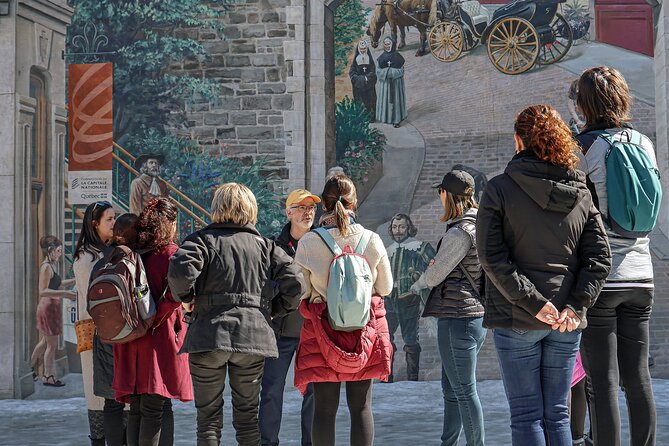
The walk then moves into the story of British Quebec. One stop recalls the British city built in the year of the Louisiana Purchase, about two decades after American independence.
That timing matters. Quebec was developing as a British North American stronghold while the United States was expanding south and west. The city’s history cannot be separated from the new republic across the border.
You also visit a stronghold added to Quebec’s defenses after the War of 1812, when American military pressure remained a concern. Its position facing the American threat shows why Quebec continued to be treated as a strategic post long after the French conquest.
The fortifications make more sense when you see the city’s geography. Quebec controlled access along the St. Lawrence, so walls, batteries, gates, and elevated positions were not decorative features. They protected a route leading deep into the continent.
The Plains of Abraham and the French defeat
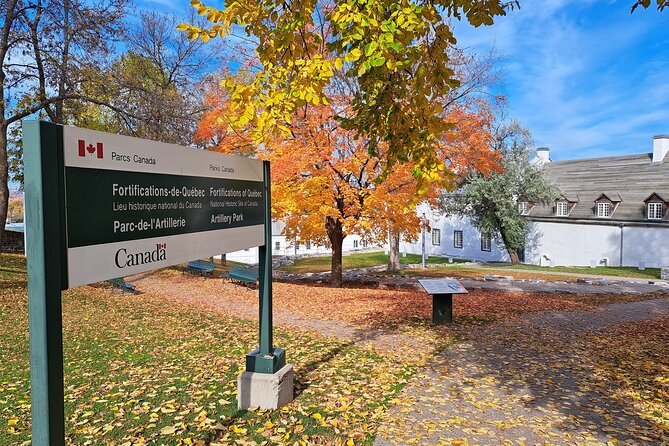
The Plains of Abraham are the key battlefield of the French and Indian War in North America. Here, the British defeated the French, and the 1763 Treaty of Paris confirmed that Canada would become British.
This is a useful place to compare Quebec with better-known American battlefields. At Yorktown and Chalmette, the results favored the forces that later shaped the United States. At Quebec, the British victory changed the future of Canada.
A good guide can keep the battle from becoming a simple list of generals and dates. The important point is what followed: French Canada remained culturally and linguistically distinct, but political control passed to Britain.
The tour’s Canadian perspective is particularly valuable for Americans. Michel has directly emphasized the relationship between the two countries and the events of 1775 and 1776, giving you a view that differs from the usual American Revolutionary War account.
Walking the walls around Old Quebec
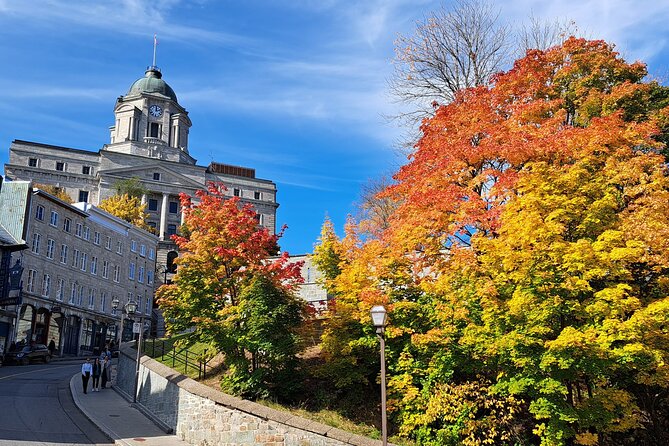
The French and British ramparts protected this strategic outpost and its control of the St. Lawrence. The walls are among the clearest signs that Old Quebec was built as a fortress, not simply as a colonial town.
You can expect the route to explain how the defenses changed over time. The city’s military system grew after conflicts with France, Britain, and the United States, and different periods left their mark on the same stone streets.
One of the stops is a gate in the French rampart. The original military structures had narrow openings and doors, but those features were later removed. The gate was rebuilt with a medieval appearance as part of Lord Dufferin’s 1875 Quebec Improvement plan, influenced by the European historicist movement.
That detail is worth knowing because Old Quebec looks older than every part of it really is. Some features are original military works, while others were reshaped in the nineteenth century to create a more picturesque historic city.
Parliament and the French Catholic institutions
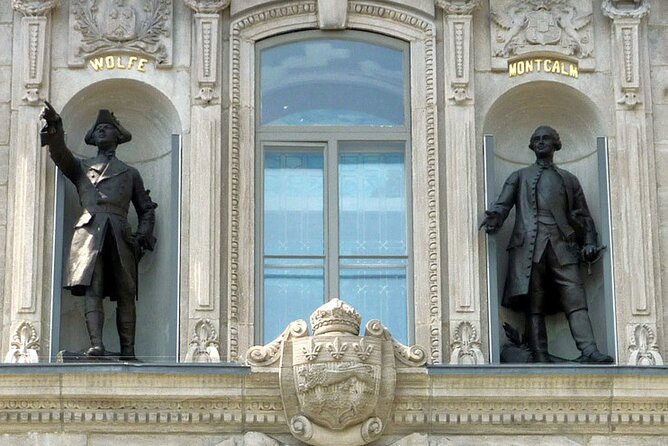
The provincial legislature is another important stop. Quebec City is the capital of Quebec, the only French-speaking province in Canada, even though Montreal is larger and more populated.
That distinction is easy to miss if you simply arrive for the old streets. The city is not only a preserved historic district. It remains the political capital of French Canada.
The route also includes the first school for girls in North America, along with a major museum devoted to French art and Catholic education. This institution is among the leading French heritage sites in Old Quebec and Canada.
You then visit the first hospital in North America, now connected with a world-class wellness center and museum. These sites show how French Catholic institutions shaped daily life, education, medicine, and missionary work across the continent.
For me, these stops add needed balance. Military history often takes center stage in Quebec City, but schools and hospitals explain how a society actually endured and grew.
Notre-Dame, the Seminary, and French America
The founding cathedral of Catholicism in French America is another major stop. It heads a diocese that once extended across an enormous part of the continent, from Quebec City toward New Orleans.
That scale may surprise you. Quebec was not just the religious center of one small settlement. Its Catholic authority reached through French territories in North America.
The tour also visits the school that trained French Catholic missionaries sent across the continent to convert French territories to Catholicism. Today, the site is associated with Laval University’s School of Architecture and a high school.
These buildings help explain why Quebec’s French identity survived political change. Language, faith, education, and local institutions gave the community a lasting structure after British rule began.
Upper Town, Lower Town, and the city’s two levels
The Upper Town route mainly covers the UNESCO World Heritage area inside the walls. It has an unusually high concentration of sites covering four centuries, so you will see a lot in a short distance.
The Lower Town centers on Place Royale, Petit-Champlain, and the Old Port. Its streets tell a different part of the story, tied to trade, shipping, commerce, and the city’s earliest settlement.
You will likely feel the difference in your legs as much as in the architecture. The city rises sharply between the two levels, and the tour includes the stairs linking Petit-Champlain with Upper Town.
That climb is an important practical point. You do not need an athlete’s fitness, but you should be comfortable walking on hills and stairs for about two and a half hours. Wear supportive shoes, especially if you plan to continue exploring afterward.
The Price Building and Quebec’s changing economy
The Price Building is an unusual landmark on the route. Built in 1929 as the headquarters of a pulp and paper company, it represents both the industrial economy and the hardship of the Great Depression.
Its story also follows a six-generation Welsh family now involved in high-end tourism in Quebec City. That connection gives the building a human angle, linking business, family continuity, economic crisis, and the city’s modern visitor economy.
This is the sort of detail that can disappear on a standard sightseeing walk. A private guide has room to explain how one building fits into the larger story of Quebec’s fortunes.
Place Royale, the birthplace of Canada
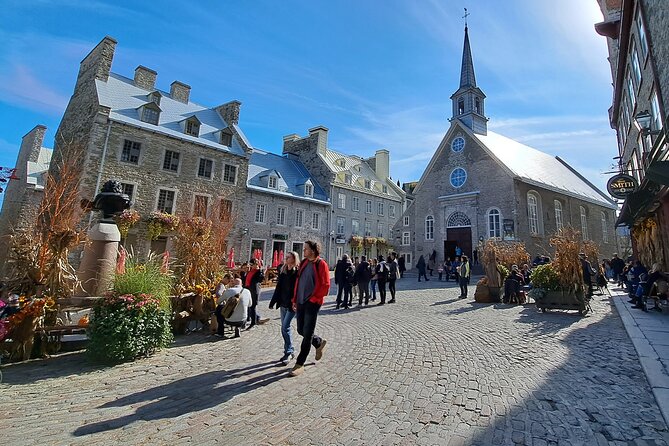
Place Royale is the historical heart of Lower Town. Quebec City was founded here by Samuel de Champlain in 1608, and the site has been continuously occupied since then.
The comparison to Jamestown and Williamsburg is useful. This is both a birthplace of Canada and a surviving historic district, though it also became the proposed site of a museum district project that was never completed in the 1970s.
The area gives you a chance to connect the earliest settlement with later commercial life. Quebec did not begin as a museum piece. It was a working port and trading center before preservation and tourism changed how people encountered it.
Petit-Champlain and the Old Port
Petit-Champlain is one of the three leading shopping areas in Old Quebec. Its current character came from a 1980s project led by two local architects who wanted to bring high-end artisan shops into a declining Old Port area.
That recent history is worth hearing because the district can appear entirely old-world. The shopping streets are historic in setting, but their revival is part of late twentieth-century urban planning.
The route also includes one of Old Quebec’s top museums, with exhibitions about Canada and Native Americans. This adds Indigenous history to a tour that otherwise focuses heavily on French, British, and American power.
You should allow extra time to return to these areas after the tour if you want to shop or visit museum interiors. The walking experience gives you the context, but a short tour cannot provide a full visit to every institution along the route.
The 1775 invasion and the Old Financial District
The final section covers the failed American invasion of Canada in 1775. Benedict Arnold and Richard Montgomery were both defeated here, making Quebec City one of the most important northern episodes in the American Revolutionary War.
The site also occupies land reclaimed from the water during the French, British, and Canadian periods. That means the ground beneath the streets is part of the city’s engineering history as well as its military past.
This was once Canada’s old financial district and is now associated with art and antique shops. The change from finance to heritage commerce gives you a quick look at how Quebec’s economy has shifted over time.
The tour finishes with more defensive features, including a military cannon platform added during King William’s War. At that time, Frontenac defeated invaders from Boston led by William Phips.
Taken together, these stops give you a clear reason Quebec City mattered. Its river position, high ground, walls, and port made it a prize for France, Britain, and the United States.
What the $213.92 group price gets you
The listed price is $213.92 per group of up to 10 people, not per person. For a full group, that works out to about $21.39 per person for two and a half hours of private guiding.
For two people, the per-person cost is much higher. Still, you are paying for a private experience, direct questions, flexible attention, and guiding services rather than joining a large group with a fixed script.
I see the best value for families, multigenerational groups, and friends traveling together. A seven-year-old and a thirteen-year-old can receive explanations suited to their age, while adults can ask about military history, architecture, or the relationship between Quebec and the United States.
The tour has earned praise for flexibility and for adapting to group needs. That does not mean every stop can become a long museum visit, but it does suggest that the format is more personal than a standard city orientation.
Who should book this Quebec City walk?
I would choose this tour early in a Quebec City visit. It covers both Upper and Lower Town and gives you a useful mental map before you return on your own.
It suits you best if you:
- Want a strong introduction to Quebec’s history and culture
- Care about the connection between Canadian and American history
- Prefer a private guide to a large scheduled group
- Are traveling with children or different age groups
- Enjoy architecture, military sites, religion, and urban history
- Can manage hills and stairs for about two and a half hours
It is less suitable if you want long interior visits at every museum, a relaxed café-focused walk, or a completely flat route. The itinerary is ambitious, so the guide needs to keep moving.
Pickup is offered from Old Quebec hotels, and a meeting point can be arranged if you stay elsewhere. The tour is offered in English, includes mobile ticketing, and allows service animals. Confirmation is sent within 48 hours, subject to availability.
Free cancellation is available up to 24 hours before the start time. Changes or cancellations made inside that window are not accepted for a refund.
Should you book it?
Book this tour if you want Quebec City’s major stories explained in one sitting, especially the French and British struggle for Canada and the failed American invasion of 1775. The private format, visual materials, and flexible guide attention make the price sensible for a group of several people.
I would be especially inclined to book with Michel Perron if you enjoy history told through maps, timelines, and local perspective. His strength is not just naming buildings. It is showing how the city’s walls, churches, schools, battlefields, port, and political institutions fit together.
Skip it only if you dislike hills, stairs, or a brisk itinerary. For most first-time visitors with moderate fitness, this is a strong way to get your bearings fast and understand why Quebec City remains central to the story of French Canada.
FAQ
How long is the Old Québec and French Canada Private History Walking Tour?
The tour lasts approximately 2 hours and 30 minutes.
How much does the tour cost?
The price is $213.92 per group, with up to 10 people included.
Is the tour private?
Yes. Only your group participates in the activity.
Is hotel pickup available?
Yes. If your hotel is in Old Quebec, the guide meets you in the hotel lobby five minutes before the tour. If your hotel is outside Old Quebec, an easy-to-find meeting point is suggested.
What language is the tour offered in?
The tour is offered in English.
How much walking is involved?
The route involves about one mile of walking, along with hills and stairs between Upper Town and Lower Town. A moderate level of physical fitness is recommended.
Does the tour include museum admission?
The included service is guiding. The provided information does not state that museum admission fees are included.
Are service animals allowed?
Yes, service animals are allowed.
Can I cancel for a full refund?
Yes, if you cancel at least 24 hours before the experience start time. Cancellations made less than 24 hours before the start are not refunded.
Newest reviews from Quebec City
- Quebec City: Electric Bike Tour★ 4.7 · 6 reviews
- Heritage Upper Town E-Bike Tour★ 5.0 · 6 reviews
- Private tour of Quebec City 4 hours★ 5.0 · 6 reviews
- Guided cruise to discover Orleans Island and Quebec City★ 4.6 · 6 reviews
- Quebec City Scenic Walking Tour with 1 Funicular Ride★ 4.5 · 7 reviews
- Quebec City Old Town Private Self Guided Walking Tour★ 4.5 · 7 reviews
- Quebec: Christmas Interactive Walking Tour of New France★ 4.3 · 7 reviews
- Quebec City Self-Guided Driving Audio Tour★ 4.0 · 7 reviews
Quebec City Tours, compared.

Half-Day Trip to Montmorency Falls and Ste-Anne-de-Beaupré from Quebec city
Read our review →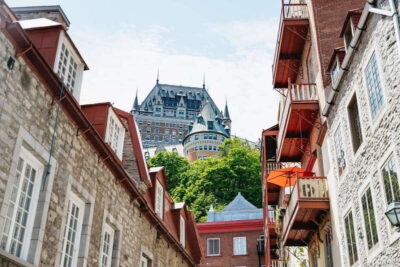
Old Quebec City: Grand Walking Tour with Private Option
Read our review →
Montmorency Falls & Ile d’Orleans Half-Day Tour
Read our review →
Hop-on Hop-off Open-Top Double Decker Bus Tour
Read our review →Browse the lists this tour appears in