

Reviewed · HALIFAX TOURS
Half-Day Historical Tour of Halifax
Halifax rewards curiosity. This six-hour tour ties the city’s military, maritime, Titanic, and immigration stories together, with Paul McNeil guiding a small group through Halifax, Dartmouth, and Fisherman’s Cove. I like the maximum 10-person group and the comfortable van with a mounted tablet for photos, videos, and maps. I also like the mix of major sights and lesser-seen places, from cemeteries to the Mont Blanc anchor. The main drawback is pace: you spend plenty of time in the vehicle, and a long port day may force you to leave early.
This is a history lesson on wheels, not a relaxed walking tour. Paul is passionate, organized, and generous with local detail, but his commentary is constant because the route covers so much ground. If you want a broad introduction before exploring Halifax on your own, this tour gives you a strong start. If you prefer museums, long photo stops, or free time, you may find it too packed.
In This Review
- Key points at a glance
- A six-hour introduction to Halifax
- Pier 21 and Halifax’s waterfront story
- Harbor defenses, breweries, and ships
- Downtown Halifax, from churches to government
- Cemeteries that tell Halifax’s difficult stories
- The Citadel and the noon gun
- The Halifax Explosion and the Mont Blanc anchor
- Parks, universities, and the Dartmouth crossing
- Fisherman’s Cove and the seafood stop
- Who should book this Halifax tour?
- Should you book it?
- FAQ
- How long does the tour last?
- Where does the tour begin?
- How many people can join the tour?
- Is lunch included?
- Is admission to the Halifax Citadel included?
- What happens if the weather is poor?
Key points at a glance

- Paul McNeil’s personal storytelling: He brings together Halifax’s stories of the Titanic, the 1917 explosion, military defense, immigration, and local people.
- Small-group transportation: The Ford Transit 350 XLT High Roof van carries four to ten participants, with pickup from downtown hotels or the cruise area.
- A serious history route: You see the Citadel, old churches, cemeteries, the waterfront, Fort Needham, Dartmouth, and Fisherman’s Cove.
- The noon military tradition: The schedule includes the Citadel’s noon gun and the changing of the guard, though timing can depend on the day’s route.
- Titanic and Halifax Explosion sites: Fairview Lawn Cemetery, Mount Olivet Cemetery, the Mont Blanc anchor, and the Explosion Memorial receive special attention.
- A useful first-day orientation: The tour helps you understand what shaped Halifax before you return to favorite areas independently.
A six-hour introduction to Halifax
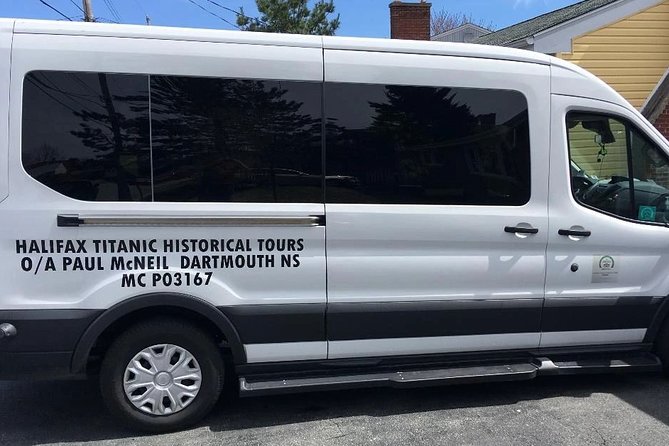
At $131.43 per person, this is not the cheapest way to see Halifax. It is good value if you want transportation, a guide, bottled water, onboard WiFi, and a tightly planned route that reaches both sides of the harbor.
You are paying mainly for access to Paul’s local knowledge and for the time saved by driving between scattered sites. A regular walking tour cannot easily cover Point Pleasant Park, the cemeteries, Dartmouth, Fairview Lawn, and Fisherman’s Cove in one outing. The price makes more sense for cruise passengers, first-time visitors, and anyone who wants the city’s difficult stories explained with care.
The group size matters. With four to ten people, you get a more personal setting than on a large coach. Paul can answer questions, adjust small details, and help with seating or mobility needs. The high-roof Ford Transit is easier to enter and exit than a low minibus, although the first confirmed participants receive the first choice of seats.
Pickup is available at listed downtown hotels. Cruise passengers and people driving can meet at Pier 22, 1041 Marginal Road, where all-day parking is listed at $10 CAD. The tour returns to the meeting point, though a cruise passenger with a short port call should confirm the return plan before booking.
More historical tours:
- Peggy’s Cove & Halifax Historic Tour
★ 4.5 · 375 reviews - Historic Halifax by Foot
★ 4.5 · 191 reviews - Peggy’s Cove/Mahone Bay & Lunenburg UNESCO HERITAGE SITE.
★ 4.5 · 139 reviews
Pier 21 and Halifax’s waterfront story
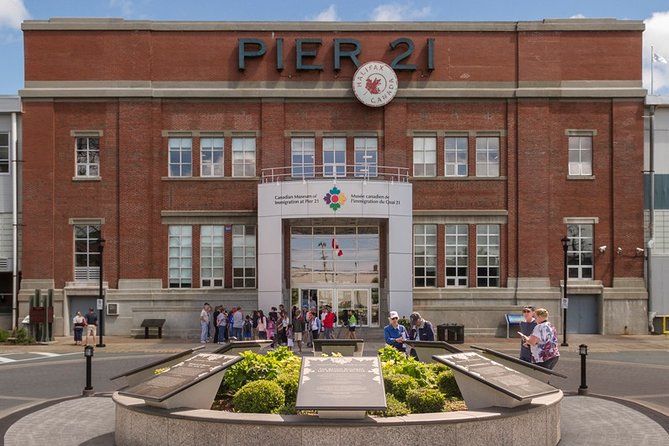
The tour begins near Pier 21, one of the clearest places to understand Halifax as a gateway. Your guide explains the role of this port in Canadian immigration and the many people who arrived by ship to begin new lives.
Nearby, the Halifax Seaport Farmers’ Market connects present-day Halifax with its colonial beginnings. The market was created by royal proclamation in 1750, only a year after the city was founded. It moved through several locations before settling at the Seaport in 2010 and is now home to more than 250 vendors.
You also hear about the Cunard family and Sir Samuel Cunard, the Halifax-born founder of the Cunard Line. This is a useful reminder that Halifax’s identity is not only military. Shipping, trade, immigration, fishing, and ocean travel shaped the city just as strongly.
The waterfront boardwalk then provides a visual orientation to the harbor. Halifax has one of the world’s largest natural harbors, and the tour explains why that waterway made the city so important to the British Empire and to Canada’s naval past.
Harbor defenses, breweries, and ships
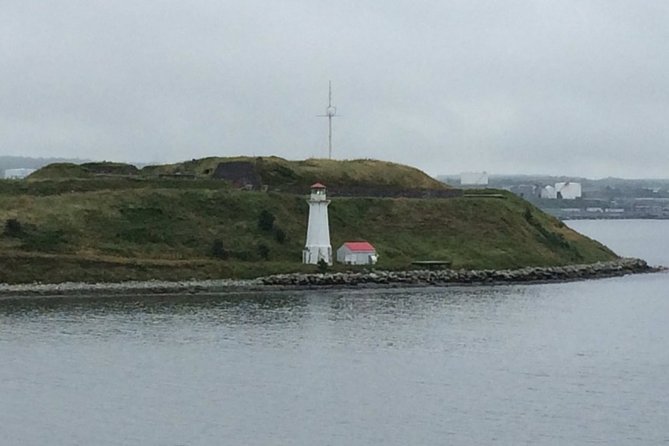
Georges Island sits in the harbor’s strategic center. British forces occupied it in 1750, and it later became part of Halifax’s network of sea defenses. Fort Charlotte, batteries, tunnels, and a lighthouse all formed part of its story.
The island also has a painful connection to the deportation of the Acadians between 1755 and 1763. Large numbers of Acadians were held there during Le Grand Dérangement. The underground passages have also fed local legends, giving the island a darker, more mysterious character.
The route passes Alexander Keith’s brewery, where you hear about the Halifax brewer whose Nova Scotia Brewery opened almost two centuries ago. The brewery still operates as a visitor destination and produces small-batch beer inspired by local culture. Alcohol is not included, so think of this as a historical stop rather than a tasting visit.
HMCS Sackville adds a naval chapter. It is the only surviving Allied corvette from the Second World War that still serves as Canada’s Naval Memorial. It is also a National Historic Site, and its survival gives the story a physical focus.
The Maritime Museum of the Atlantic is recommended as an optional visit before or after the tour. It covers the age of sail, steamships, wartime convoys, the Titanic, and the Halifax Explosion. Since museum admission and extended museum time are not part of the tour, plan a separate visit if those subjects interest you.
Downtown Halifax, from churches to government
The central city portion moves past a remarkable run of historic buildings. Historic Properties contains three blocks of restored waterfront warehouses dating from the late 1700s and early 1800s. Its Victorian-Italianate façades give you a strong sense of old Halifax without needing a long walking circuit.
Saint George’s Round Church has a different mood. Built in 1800 for the growing congregation of the Little Dutch Church, its unusual cylindrical wooden design reflects the Palladian taste of Edward, Duke of Kent. Your guide also explains its sad history, adding human weight to what might otherwise look like an architectural curiosity.
St. Paul’s Church was founded in 1749 and was the first Anglican cathedral built outside England. It is also Halifax’s oldest building. Look for the Ghost Window and the piece of wood set into an interior wall, both connected with the 1917 Halifax Explosion.
The route continues past Halifax City Hall, built between 1887 and 1890, and Province House, which opened in 1819. Province House is Canada’s oldest legislative building and the home of the country’s first elected House of Assembly. Government House, the oldest official residence in Canada, remains the working residence of Nova Scotia’s lieutenant governor.
You also pass Saint Mary’s Cathedral Basilica, the Halifax Court House, All Saints Cathedral, and the city’s modern central library. The library’s design, said to resemble a stack of books, received international attention after opening in 2014.
This stretch is packed with information. I find that useful if you want context, but it can feel like a parade of façades if you hope to enter each building. Most are viewed from the vehicle or during brief stops, so bring questions and take notes for a later self-guided walk.
More half-day tours:
- Half-Day Small-Group Tour of Nova Scotia’s South Shore
★ 5.0 · 119 reviews - Vancouver Half-Day Whale Watching Adventure with Free Photos
★ 5.0 · 5,000 reviews - Half-Day Trip to Montmorency Falls and Ste-Anne-de-Beaupré from Quebec city
★ 4.0 · 2,718 reviews - Victoria Half-Day Whale Watching Adventure with Free Photos
★ 5.0 · 2,259 reviews
Cemeteries that tell Halifax’s difficult stories
Halifax’s cemeteries are not incidental stops. They help explain the city’s military, religious, political, Titanic, and disaster history.
The Old Burying Ground contains more than 1,200 headstones and footstones from the 18th and early 19th centuries. Its stone wall and iron fence create a quiet pocket in the downtown core. The Crimean War monument at the Barrington Street end adds another layer to the site.
Camp Hill Cemetery replaced the Old Burying Ground in 1844. Notable people buried there include Viola Desmond, Alexander Keith, Joseph Howe, Titanic survivor Hilda Mary Slayter, and John Taylor Wood, a Confederate naval officer with notable American family connections. The stop is listed at about 10 minutes.
You also visit Holy Cross Cemetery, where roughly 25,000 people have been buried since 1843. Many were of Irish descent, including Sir John Sparrow Thompson, Canada’s fourth prime minister. Within the cemetery is Our Lady of Sorrows Chapel, built in one day in 1843 by more than 1,800 people. Its French stained glass dates from the 16th and 17th centuries.
The Titanic connection continues at Mount Olivet Cemetery, where 19 Roman Catholic Titanic victims are buried. Fairview Lawn Cemetery contains 121 Titanic graves, including the well-known marker for J. Dawson and the grave of Sidney Leslie Goodwin.
These stops are quiet and respectful. Paul’s use of photographs and video in the van helps explain the people behind the names. If you want extended time at each grave, you should ask in advance, since the itinerary must keep moving.
The Citadel and the noon gun

The Halifax Citadel is the tour’s most recognizable military sight. The present Fort George was completed in 1856 and is the fourth fort built on Citadel Hill. Its star-shaped design gave soldiers wide firing lines and made the position extremely difficult to attack.
A major attraction is the noon gun, a Halifax tradition dating to 1856. The itinerary also aims to include the changing of the guard by the 78th Highlanders. The timing is important, so do not treat this as a flexible stop. You are scheduled for about 15 minutes, and admission to the Citadel is not included.
The Old Town Clock follows naturally. Prince Edward, Duke of Kent, arranged for its turret clock in 1800 because the local British garrison had a reputation for lateness. It is an amusing detail, and a good example of how Halifax’s military past appears in everyday city landmarks.
The Halifax Explosion and the Mont Blanc anchor

The 1917 Halifax Explosion is one of the central stories of this experience. On December 6, the munitions ship SS Mont Blanc exploded in the harbor, killing approximately 1,900 to 2,000 people, injuring 9,000, and leaving 25,000 homeless.
At the Mont Blanc Anchor Site, you see an anchor shaft weighing 1,140 pounds that was thrown roughly 2.3 miles by the blast. Another cannon was hurled nearly three miles to Albro Lake in Dartmouth. These objects make the force of the explosion easier to grasp than numbers alone.
Fort Needham’s Halifax Explosion Memorial Bell Tower overlooks the area that suffered the greatest damage. The tower honors those who died, those who were injured, the families who lost homes, and the people who rebuilt Halifax and Dartmouth. The stop is listed at about 20 minutes.
The nearby Hydrostone district shows part of that rebuilding effort. After wooden houses collapsed onto stoves and furnaces, planners sought safer construction. Hydrostone blocks, made from concrete faced with crushed granite, were manufactured in Eastern Passage and brought across the harbor by barge.
This part of the tour is especially powerful because it links a disaster, engineering, urban planning, and personal loss. The stories are somber, but they are handled as part of Halifax’s living identity rather than as a sensational spectacle.
Parks, universities, and the Dartmouth crossing

Point Pleasant Park covers 75 hectares at the southern end of the Halifax peninsula. Its trails pass coastal areas and old fortification ruins. Halifax leases the park from the British government for one shilling per year under a 999-year lease, an odd but memorable detail.
The route also passes Dalhousie University, founded in 1818, and the University of King’s College, established in 1789. King’s is Canada’s oldest chartered university and the first English-speaking university in the Commonwealth outside the United Kingdom.
Across the harbor, Lake Banook in Dartmouth is associated with canoeing, kayaking, rowing, and dragon boating. It also claims a connection with the birth of ice hockey. These stops broaden the tour beyond old buildings and memorials.
Sir Sandford Fleming Park, known as The Dingle, was donated to Halifax in 1908 by the creator of standard time zones. The Dingle Tower, dedicated in 1912, commemorates 150 years of representative government. The listed stop is about 10 minutes.
Fisherman’s Cove and the seafood stop
Fisherman’s Cove is a welcome change of pace. This restored, 200-year-old working fishing village has colorful buildings and easy photo opportunities. You get about 30 minutes to look around, which is enough for a short stroll but not a long visit.
Lunch at Evan’s Seafood is optional and not included in the tour price. Food orders are called ahead to reduce waiting, and the setting offers a view of Halifax. Fresh Nova Scotia seafood and gluten-free choices are available, but you pay separately, and alcohol is excluded.
The lunch stop has received mixed personal reactions, so I would treat it as convenient rather than a guaranteed highlight. If seafood is not your preference, check the available choices when you are contacted or ask Paul before the tour.
Who should book this Halifax tour?
I would choose this tour if you want maximum historical coverage in one day. It suits first-time visitors, cruise passengers with enough time in port, families, couples, solo visitors, and people who do not want to walk long distances between sites.
It also works well for someone with mobility limits because much of the sightseeing is done from the van, with several short walks. That said, you still need to get in and out of the vehicle at multiple stops, and the tour is not a substitute for a fully accessible private itinerary unless your needs are confirmed ahead of time.
I would not choose it if your ideal day means lingering in one museum, taking many photographs, or spending hours at the waterfront. The route is ambitious. You hear a lot, see a great deal, and often have only 10 to 30 minutes outside the van.
The tour requires at least four participants and accepts up to ten. Confirmation arrives at booking, service animals are allowed, and the activity operates in English. Free cancellation is available up to 24 hours before departure. Poor weather or an insufficient number of participants can lead to a new date or a full refund.
Should you book it?
Book this tour if Halifax is new to you and its story matters as much as its scenery. Paul McNeil’s strongest qualities are his preparation, local pride, clear timing, and command of the city’s complicated past. The tablet presentation is a real advantage when old photographs and short videos help you picture the Titanic, the Explosion, or a vanished waterfront.
Before paying, check your port schedule carefully. A short call may mean missing Dartmouth or Fisherman’s Cove, and you should confirm exactly where and when you will return. For most first-time visitors with a full morning and afternoon, this is an efficient and unusually wide-ranging introduction to Halifax. Plan a separate visit to the Maritime Museum of the Atlantic afterward, then spend the rest of your stay returning to the places that caught your attention.
FAQ
How long does the tour last?
The tour lasts approximately six hours and ends back at the meeting point.
Where does the tour begin?
The meeting point is Pier 22, 1041 Marginal Road, Halifax. Pickup is also offered at listed downtown hotels.
How many people can join the tour?
The tour requires a minimum of four participants and has a maximum of ten.
Is lunch included?
No. Lunch at Evan’s Seafood is optional and paid separately. Alcoholic beverages are also not included.
Is admission to the Halifax Citadel included?
No. Admission to the Halifax Citadel is not included in the tour price.
What happens if the weather is poor?
If poor weather causes cancellation, you will be offered another date or experience, or a full refund.
Newest reviews from Halifax
- Halifax Sunset Cruise Ft. a Live Musician★ 4.5 · 47 reviews
- JFarwell Moonlight Yacht Cruise from Halifax Waterfront★ 5.0 · 48 reviews
- Peggy’s Cove, Lunenburg & 2 Hidden Gems – Full Day Tour★ 5.0 · 56 reviews
- Halifax waterfront SOLAR Party Bike food & drink experience!★ 4.0 · 71 reviews
- Halifax: Tall Ship Harbor Sailing Cruise with Live Music★ 4.5 · 75 reviews
- Best of Halifax Harbour Boat Tour★ 5.0 · 77 reviews
- Peggy’s Cove, Lunenburg & 2 Hidden Gems – Full Day Tour★ 5.0 · 83 reviews
- Peggy’s Cove Express Tour: Scenic Guided Experience★ 4.5 · 85 reviews
Halifax Tours, compared.





Small Group Tour – Peggy’s Cove, Lunenburg, the Annapolis Valley
Read our review →

Halifax Premium Tour: Peggy’s Cove, Citadel & Titanic Cemetery
Read our review →
Tall Ship Silva Sailing Cruise Ft. a Live Musician
Read our review →Browse the lists this tour appears in